
Electronic Cigarette Trade Association of Canada

...transparency. Consumers should never have to guess.
Nicotine Yield Study
In December of 2013, ECTA chartered a study using Enthalpy Labs, a Health Canada accredited facility which measured the amount of nicotine that an Electronic Cigarette user would receive when using various current generation devices and the highest strength E-Liquid level permitted at the retail level by an ECTA Member.
This document only serves as a general, high level summary of that study with detailed lab results available for download, free of charge to the public from our website. ( Download: This Handout PDF | Full Study PDF )
There were three primary purposes for the nicotine yield study:
- To compare and determine the efficiency of nicotine delivery for modern e-cigarette devices on the Canadian Market.
- To verify that electronic cigarettes are exempt from the prescription drug list (formerly Sched. F) of the Food and Drugs Act.
- To determine the viability of current technology as suitable for medical device classification.
Three popular current generation e-cigarettes were tested to evaluate the quantity of nicotine contained in the aerosol produced. Most current studies use an effective, although slightly less accurate method of testing nicotine yield based on weight loss. By capturing the aerosol produced we can show an accurate quantity of nicotine delivered to the user upon inhalation. A modified Health Canada puff profile was used to test the devices.
- Device: Joyetech/Innokin combination. Atomizer: iClear30 Dual Coil clearomizer at 1.8ohm resistance. Battery: Manual Joyetech 1000mah Ego C upgrade with a regulated 3.7v output
- Device: KangerTech Evod. Atomizer: Kangertech bottom coil cartomizer at 1.8ohm resistance. Battery: Manual Kangertech 650mah with a regulated 3.7v output
- Device: Joyetech eRoll. Atomizer: Standard JT atomizer at 1.8ohm resistance. Battery: Joyetech automatic 90mah with a regulated 3.7v output
The highest strength e-liquid authorized for sale by ECTA members is 36mg/ml so the test was done using that strength. Six sample bottles of liquid were submitted labelled 36mg/ml and each was tested to verify the quantity of nicotine. Of the six samples submitted three were used and tested via GC/FID analysis. The three sample liquids used tested at 35.1mg/ml, 35.0mg/ml, and 35.0mg/ml respectively.
Each device was tested for 8 data point series, each series representing the total accumulation for 25 puffs. Each device was also tested twice. Represented in the graph below are the scaled results of Test 1 and Test 2. For the purpose of simplicity only the highest result from 8 data points for each test is represented in this graph.
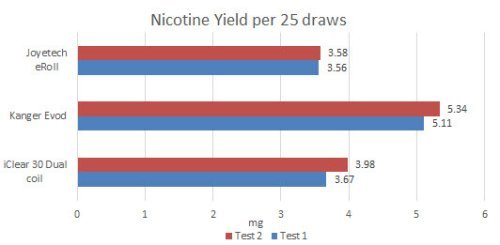
Vapour was collected from the three devices using a protocol that approximated the inhalation volume of experienced e-cigarette users. Samples were collected using an analytical smoking machine set to deliver a 55 ml 4 second puff every 30 seconds. 200 puffs were collected per device in blocks of 25 puffs. From this data, it is possible to determine the amount of nicotine delivered on a per puff basis.
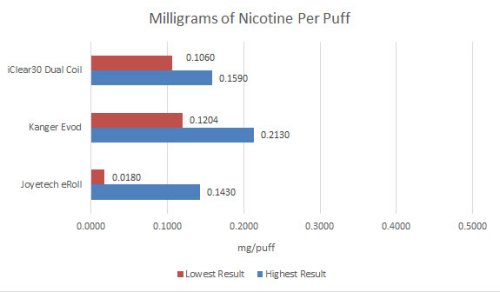
The above graph shows the total amount of nicotine produced during a 55ml 4 second draw. The highest and lowest results were taken from both test runs to show the variation in nicotine delivery. The Joyetech eRoll has a higher variation due to voltage drop on its small 90mah battery.
Although the full range of data is not represented in this summary, the results show that the latest generation of electronic cigarettes are exempt from the prescription drug list limitation of 4mg per dosage unit. In addition, the test results also show a high degree of variation in nicotine yield for each device. This indicates that they would not be suitable for the classification of a medical device as they cannot deliver a consistent and constant level of nicotine on a per puff basis.
